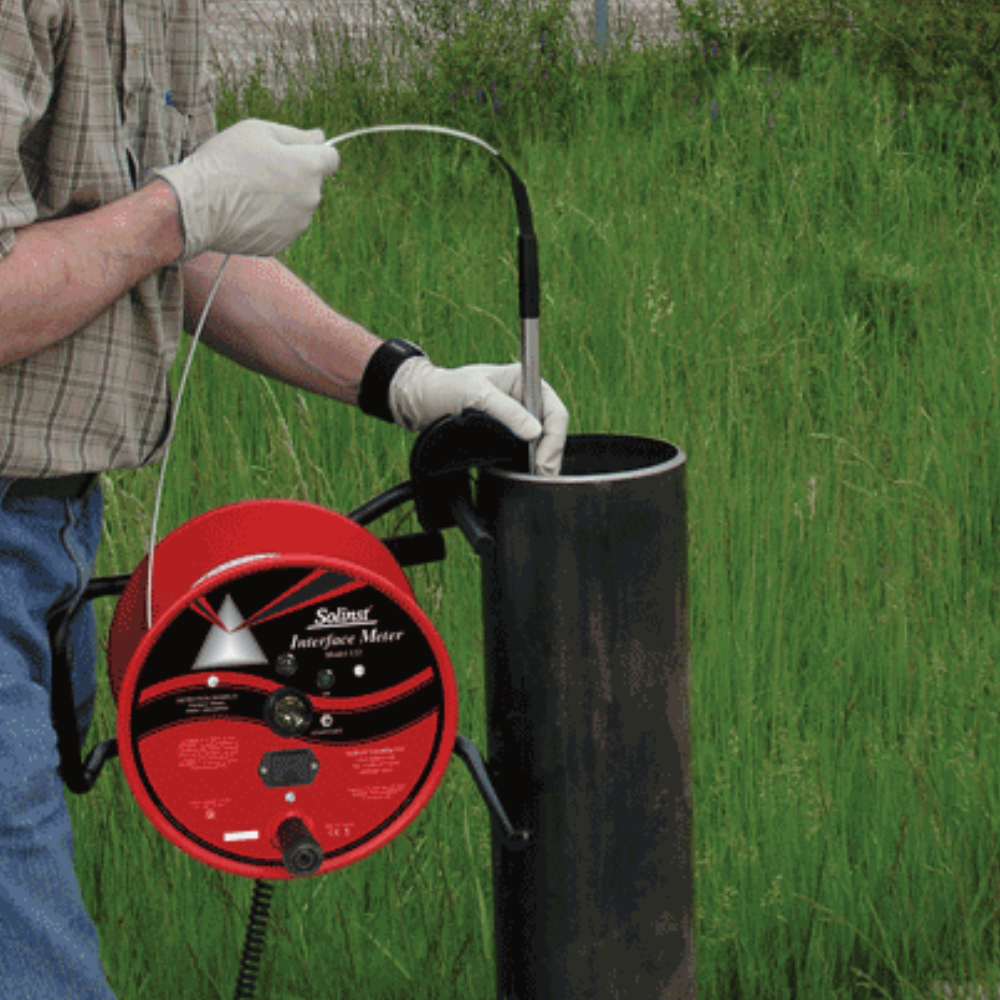


Solinst Model 122 Oil/Water Interface Meter
The Solinst Model 122 Interface Meter measures depth to water and non-conductive product interfaces in wells and tanks. It distinguishes conductive water from separate-phase liquids, supporting measurements of floating LNAPL and sinking DNAPL layers encountered during environmental investigations and remediation monitoring.
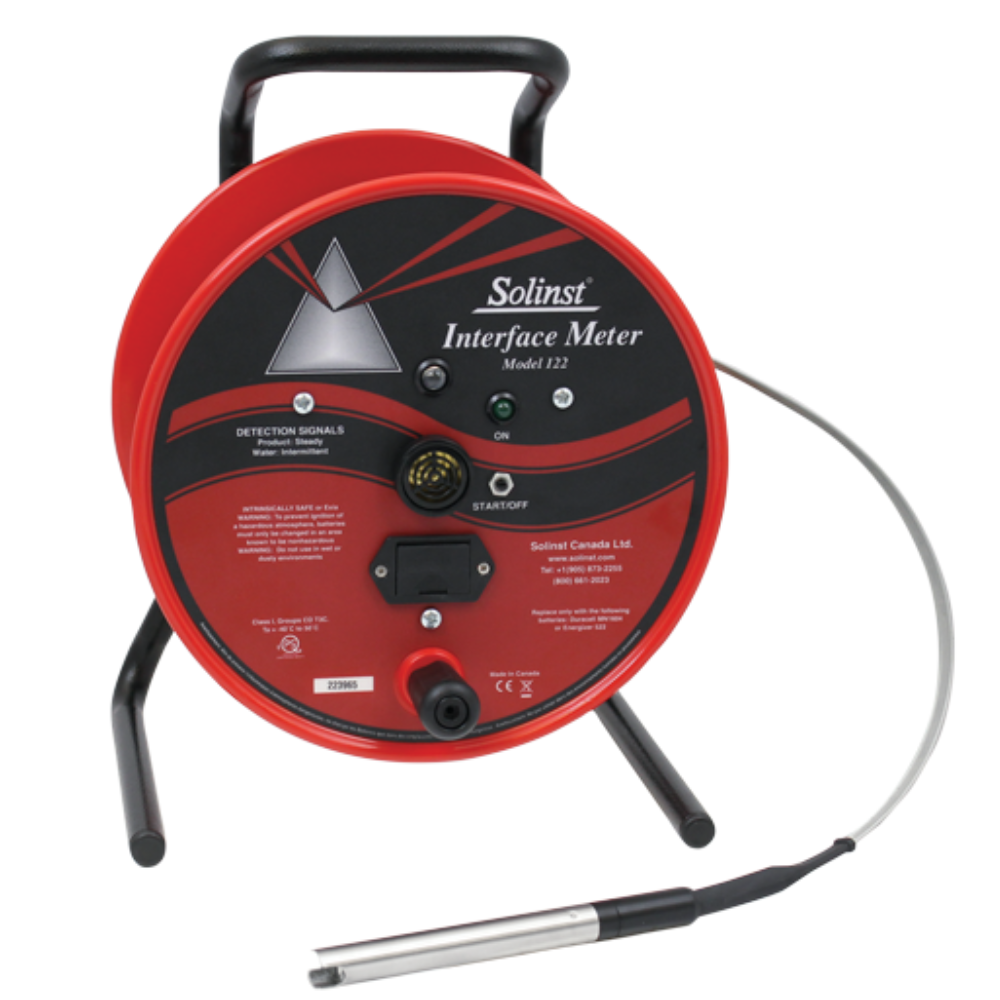
The meter combines a 16 mm (5/8 in) P8 probe with laser-marked PVDF flat tape and a portable reel. Choose an imperial configuration from 100 to 1,000 ft or a metric configuration from 30 to 300 m using the options on this page.
Different Signals for Product and Water
The P8 probe combines optical liquid detection with an electrical conductivity circuit. The optical sensor detects liquid contact, while the conductivity circuit distinguishes conductive water from non-conductive product.
- Non-conductive product: steady light and tone
- Conductive water: intermittent light and tone
Depths are read manually from the tape at your measurement reference point. The meter does not display a digital depth or automatically calculate product thickness.
LNAPL and DNAPL Layer Measurements
LNAPL refers to light non-aqueous phase liquid that can float on water. DNAPL refers to dense non-aqueous phase liquid that can occur beneath water. The 122 helps locate interfaces between these separate-phase liquids and conductive water.
For floating product, apparent layer thickness in the well is calculated from the difference between the depth to the top of product and the depth to the product/water interface. Use a consistent reference point and follow Solinst’s measurement procedure to reduce errors caused by product adhering to the probe.
The meter detects liquid interfaces; it does not identify the chemical composition of a product or measure dissolved contaminant concentrations. Product thickness observed in a well should not automatically be treated as the thickness of product throughout the surrounding formation.
P8 Probe and Laser-Marked Flat Tape
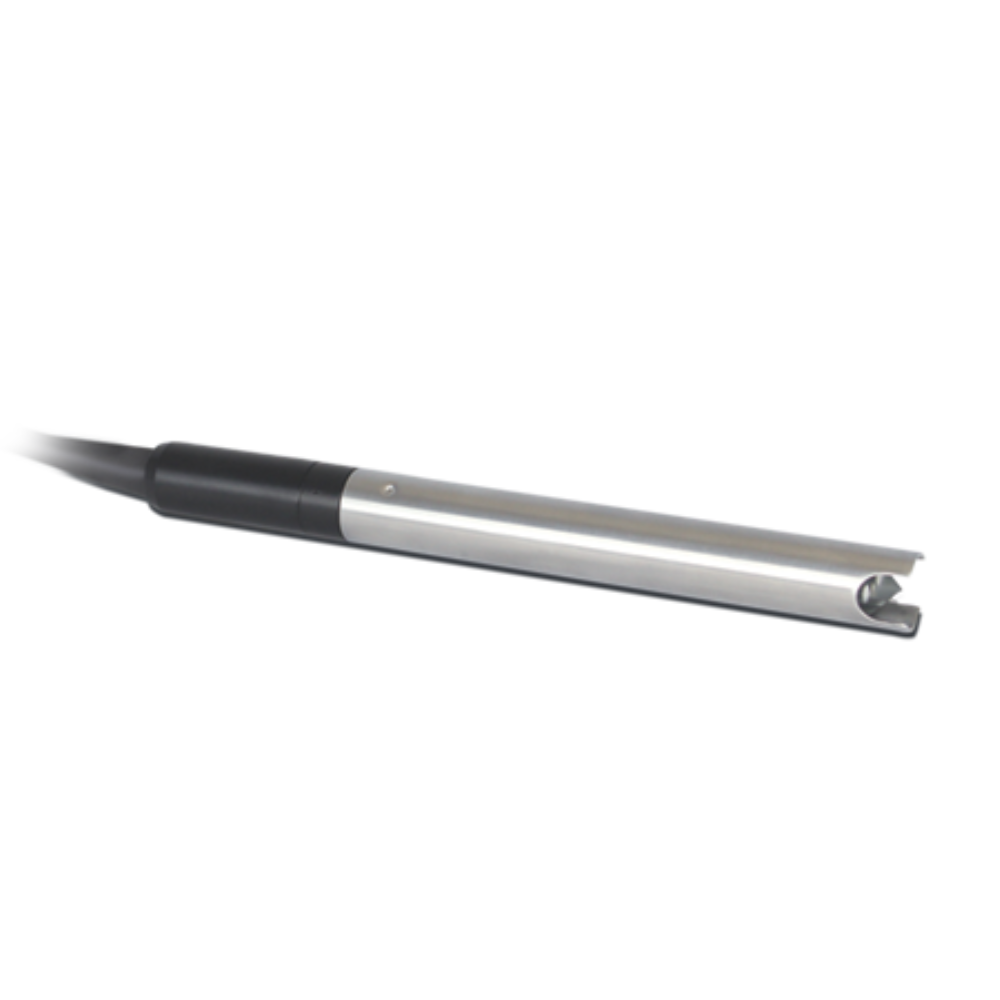
The factory-sealed P8 probe is 16 mm (5/8 in) in diameter and pressure-proof to the full length of the submerged tape. An integral stainless steel shield protects the sensing area while allowing cleaning.
The 10 mm (3/8 in) wide PVDF flat tape has permanent laser markings every 1/100 ft on LM2 imperial models or every millimeter on LM3 metric models.
Solinst describes sensor interface detection accuracy as good as 1.0 mm or 1/200 ft. This sensor specification is separate from tape graduation spacing and actual field measurement accuracy also depends on conditions and measurement technique.
Hazardous-Location Approvals and Grounding
Solinst identifies the Model 122 as intrinsically safe, with QPS approval based on CSA standards for Class I, Division 1, Groups C and D, and an ATEX designation of II 3 G Ex ic IIB T4 Gc.
Use the instrument only within the classifications, conditions, and limitations shown on its label and applicable certification documents. Confirm suitability for your site before use.
Always ground the meter using its grounding cable as directed by Solinst. Follow the operating instructions for approved battery types, battery replacement, environmental restrictions, and equipment handling. The probe’s submergence rating does not apply to the reel.
Applications
- Locating oil/water interfaces in monitoring wells
- Measuring apparent floating product thickness in wells
- Investigating accessible sinking product layers
- Environmental site assessment and remediation monitoring
- Product and water interface measurements in compatible tanks
The 122 is a manual instrument and does not automatically log readings. Contact Activated Carbon Depot for help selecting tape length, measurement units, or project quantities.
Solinst Model 122 Technical Specifications
| Specification | Details |
|---|---|
| Measurement functions | Manual depth to liquid interfaces and determination of apparent separate-phase product thickness |
| Detection method | Optical liquid detection combined with electrical conductivity sensing |
| Non-conductive product indication | Steady light and tone |
| Conductive water indication | Intermittent light and tone |
| Depth reading | Read manually from the graduated tape |
| Probe | Factory-sealed P8 probe with protective stainless steel shield |
| Probe diameter | 16 mm (5/8 in) |
| Probe submergence | Pressure-proof to the full length of the submerged tape |
| Manufacturer-stated sensor accuracy | As good as 1.0 mm or 1/200 ft for interface detection |
| Tape | Laser-marked PVDF flat tape, 10 mm (3/8 in) wide |
| Imperial graduations | LM2: feet and tenths, with markings every 1/100 ft |
| Metric graduations | LM3: meters and centimeters, with markings every millimeter |
| Imperial lengths listed | 100, 200, 300, 500, 750, and 1,000 ft |
| Metric lengths listed | 30, 60, 100, 150, 250, and 300 m |
| Power supply | One manufacturer-approved 9V battery in an accessible battery drawer |
| Battery operating life | Approximately 120 hours of on-time, as stated by Solinst |
| Automatic shutoff | Five minutes |
| Equipment check | Automatic circuitry check at startup |
| Hazardous-location classification | QPS approved based on CSA standards for Class I, Division 1, Groups C and D; subject to the instrument label and certification conditions |
| Published ATEX designation | II 3 G Ex ic IIB T4 Gc; subject to applicable certification conditions |
| Grounding | Required in accordance with Solinst’s operating instructions |
| Automatic data logging | No; measurements are recorded manually |
Sensor accuracy, tape graduation spacing, and overall field measurement uncertainty are different characteristics. Follow the model-specific operating instructions and site procedures when collecting and interpreting readings.
Available Solinst 122 Models and Part Numbers
All configurations below use the P8 interface probe. Choose your tape length and measurement units before ordering.
LM2 Imperial Models — Feet
| Tape Length | Configuration | Solinst Part Number / SKU |
|---|---|---|
| 100 ft | 122 / P8 / LM2 | 114813 |
| 200 ft | 122 / P8 / LM2 | 114814 |
| 300 ft | 122 / P8 / LM2 | 114815 |
| 500 ft | 122 / P8 / LM2 | 114823 |
| 750 ft | 122 / P8 / LM2 | 114824 |
| 1,000 ft | 122 / P8 / LM2 | 114825 |
LM3 Metric Models — Meters
| Tape Length | Configuration | Solinst Part Number / SKU |
|---|---|---|
| 30 m | 122 / P8 / LM3 | 114816 |
| 60 m | 122 / P8 / LM3 | 114811 |
| 100 m | 122 / P8 / LM3 | 114812 |
| 150 m | 122 / P8 / LM3 | 114820 |
| 250 m | 122 / P8 / LM3 | 114821 |
| 300 m | 122 / P8 / LM3 | 114822 |
Before Ordering
- Choose sufficient tape length to reach the deepest interface you need to investigate.
- Select imperial or metric tape to match your field reporting procedures.
- Confirm clearance for the 16 mm probe along the full access path.
- Review compatibility with the liquids and environmental conditions involved.
- Verify that the instrument’s hazardous-location approvals meet your site requirements.
- Match the selected length, units, and part number to your purchase order.
Solinst 122 Interface Meter vs. Water Level Meters
Choose an interface meter when you need to distinguish separate-phase non-conductive product from conductive water. A standard water level meter does not provide the same product/water discrimination.
| Model | Measurement Functions | When to Choose It |
|---|---|---|
| Solinst 122 | Manual product and water interface depths; apparent product layer thickness calculated from readings | When you need to distinguish non-conductive product layers from conductive water |
| Solinst 101 P7 | Manual depth to water | When routine water level readings are sufficient |
| Solinst 101D | Manual depth to water and selectable drawdown threshold detection | When you need an alarm as falling water exposes a probe at a selected depth |
| Solinst 107 TLC | Manual depth to water, temperature, and conductivity profiling | When temperature and specific conductance readings are required |
| Solinst 201 WLT | Manual depth to water and temperature profiling | When your procedure requires water level and temperature measurements |
The 122 uses conductivity sensing to distinguish liquid types, but does not display a numerical conductivity measurement. Hazardous-location approvals are model-specific and must not be assumed to apply to the other meters in this comparison.
What’s Included with the Solinst 122 Interface Meter?
- Assembled Solinst Model 122 Interface Meter with reel, P8 probe, and selected tape configuration
- 9V battery
- Tape guide/datum
- Grounding cable
- Cleaning brush
Sold Separately
A carrying case is sold separately and is not included with the meter. Replacement parts and additional accessories are also sold separately unless explicitly listed in your order.
Use only the battery types and replacement components permitted by the manufacturer’s instructions and applicable certification.
Solinst 122 Interface Meter PDF Downloads
- Solinst Model 122 Interface Meter Data Sheet (PDF) — Features, detection principles, tape options, and published approval information.
- Solinst Model 122 Operating Instructions (PDF) — Grounding, equipment checks, field measurements, cleaning, and battery requirements.
Review the instructions and the certification information supplied with your instrument before use. Follow the grounding requirements and replace batteries only in an area known to be non-hazardous.
Solinst 122 Interface Meter Frequently Asked Questions
The Solinst 122 measures depths to product and water interfaces in wells and tanks. Operators use those readings to determine apparent separate-phase product thickness.
LNAPL means light non-aqueous phase liquid, which can float on water. DNAPL means dense non-aqueous phase liquid, which can sink below water. These terms describe separate-phase liquids rather than dissolved contaminants.
An optical sensor detects liquid contact, while a conductivity circuit distinguishes conductive water from non-conductive product. Non-conductive product produces a steady light and tone; conductive water produces intermittent signals.
A steady light and tone indicate a non-conductive liquid, such as a separate-phase oil or product layer. The signal does not identify the specific chemical present.
An intermittent light and tone indicate conductive water.
Subtract the depth to the top of product from the depth to the product/water interface, using the same reference point. Follow Solinst's procedure for locating each interface and addressing product that adheres to the probe.
No. Read interface depths from the tape and calculate the difference manually. The meter does not provide a digital thickness readout.
Not necessarily. The result describes apparent product thickness observed in the well. It should not automatically be interpreted as product thickness throughout the surrounding formation.
No. It detects liquid interfaces and distinguishes conductive water from non-conductive product. It does not identify individual chemicals or measure dissolved contaminant concentrations.
No. Its conductivity circuit helps distinguish water from non-conductive product, but it does not display a numerical conductivity reading. Consider the 107 TLC Meter when specific conductance measurements are required.
The P8 probe is 16 mm (5/8 in) in diameter. Confirm clearance along the entire access path, including restrictions around installed equipment.
The factory-sealed P8 probe is pressure-proof to the full length of the submerged tape. This does not make the reel submersible.
Solinst describes sensor interface detection accuracy as good as 1.0 mm or 1/200 ft. This is separate from tape graduation spacing and does not eliminate the effects of field conditions or measurement technique.
Imperial models are available in 100, 200, 300, 500, 750, and 1,000 ft lengths. Metric models are available in 30, 60, 100, 150, 250, and 300 m lengths.
Solinst publishes QPS approval based on CSA standards for Class I, Division 1, Groups C and D, and an ATEX designation of II 3 G Ex ic IIB T4 Gc. Confirm the instrument label, applicable certificate, and site classification before use. These approvals do not mean the meter is suitable for every hazardous location.
Yes. Solinst requires grounding for safety and proper electronic function. Connect the grounding cable as directed in the operating instructions.
No. Use only the battery types specified in the manufacturer’s instructions and instrument labeling. Replace batteries only in an area known to be non-hazardous.
No. Operators read interface depths from the tape and record the measurements manually.
No. The carrying case is sold separately.
The package includes the assembled meter with P8 probe and selected tape configuration, a 9V battery, tape guide/datum, grounding cable, and cleaning brush.
Ways to Contact Us
Activated Carbon Depot
Email: sales@activatedcarbondepot.com
Phone: 949-229-2587